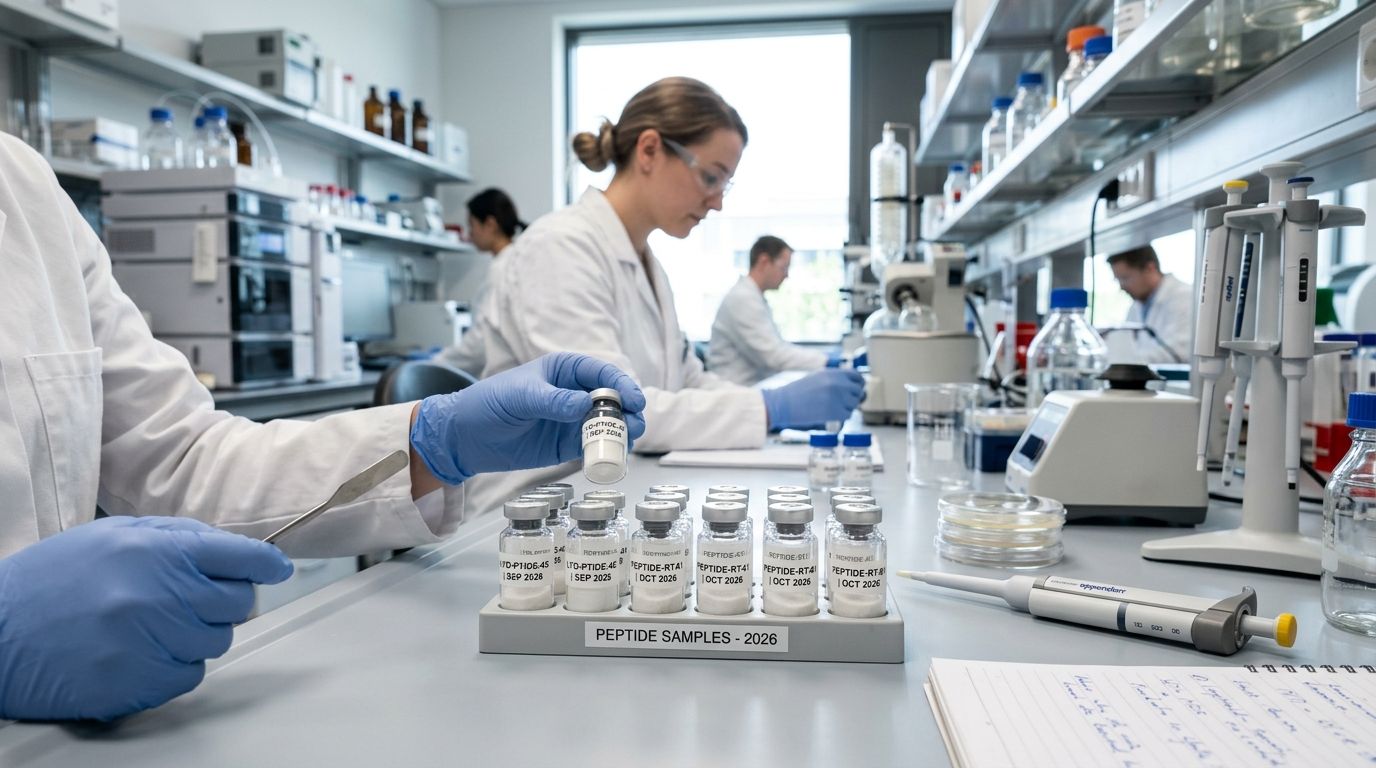
Lyophilized peptides for research labs come in dozens of sequences, but only a handful see enough laboratory demand to justify ranking by research application in 2026. This guide ranks six lyophilized peptide categories by what they're actually used for in preclinical research, not by brand, so a lab can match a category to a research design instead of guessing from a catalog list.
- BPC-157 is the best lyophilized peptide for research labs studying tissue repair and gut-barrier models in 2026.
- TB-500 (Thymosin Beta-4) ranks best for angiogenesis and vascularization research; GHK-Cu leads dermal wound-healing panels.
- Semaglutide analogs demand the most cold-chain and stability documentation of any category reviewed here.
- Lot-specific COAs and HPLC purity data separate usable research peptide categories from unusable ones, regardless of compound.
- Simple Life Science supplies lyophilized peptides for research labs across all six ranked categories with defined specifications.
Why this matters
A lyophilized peptide is only as useful as the documentation attached to the specific lot in the vial. Purity claims printed on a product page mean nothing without a Certificate of Analysis tied to that lot number, and that gap is where most procurement decisions go wrong.
Simple Life Science supplies lyophilized peptides for research labs across each category ranked below, with lot-specific analytical review attached to every shipment. The rankings that follow sort by research application, not by which compound has the biggest marketing footprint, because a peptide that's "best" for angiogenesis research is not automatically best for metabolic research.
What makes the best lyophilized peptides for research labs
- Lot-specific Certificate of Analysis with HPLC purity data and mass spectrometry sequence confirmation
- Defined synthesis route disclosed (SPPS, recombinant, or hybrid) with raw material provenance
- Stability and reconstitution data specific to the lyophilized format, not a generic liquid-peptide spec sheet
- Documented cold-chain shipping and storage conditions from synthesis to delivery
- Custom quantity and bulk peptide API availability for labs scaling a project past pilot volume
- Analytical review support that a lab can request when a lot result looks inconsistent with prior orders
Lyophilized peptides for research labs: at a glance
| Peptide category | Best for | Standout feature | Key limitation |
|---|---|---|---|
| BPC-157 | Tissue-repair and gut-barrier models | Broad citation base across preclinical injury models | Reconstitution stability sensitive to buffer pH |
| TB-500 (Thymosin Beta-4) | Angiogenesis and vascularization studies | Well-characterized fragment with predictable synthesis | Larger chain raises aggregation risk in lyophilized form |
| GHK-Cu | Dermal and wound-healing research | Copper-peptide complex is reproducible across lots | Requires heavy-metal testing on the COA |
| Semaglutide (GLP-1 analog) | Metabolic and appetite-regulation research | Extensive published pharmacokinetic literature | Long chain raises purity-verification burden |
| Epithalon | Telomerase and senescence research | Short sequence simplifies synthesis and QC | Narrower application range than other categories |
| Selank / Semax | Neuropeptide and stress-response research | Two peptides cover complementary cognitive endpoints | Regulatory status varies more by jurisdiction |
1. BPC-157: best lyophilized peptide for tissue-repair research
BPC-157 is a pentadecapeptide fragment studied in preclinical models examining gut-lining integrity and soft-tissue injury response. It's synthesized almost exclusively via solid-phase peptide synthesis (SPPS), which keeps the production route short and easy to document lot to lot.
BPC-157 pros:
- Extensive published preclinical literature across multiple injury models
- Short sequence length keeps synthesis and purification straightforward
- Wide supplier availability makes lot-to-lot comparison easier than for longer peptides
BPC-157 cons:
- Sequence identity and purity vary widely across suppliers without third-party verification
- Reconstitution stability depends heavily on buffer choice and storage temperature
Best for: labs running tissue-repair or gut-barrier preclinical models. Verdict: Buy — prioritize BPC-157 first if tissue-repair research is the primary program focus in 2026.
2. TB-500 (Thymosin Beta-4): best for angiogenesis research
TB-500 is a synthetic fragment of thymosin beta-4, studied for its role in actin regulation and used in vascular and angiogenesis research models. The synthesis route is well-established, and lyophilization behavior is predictable across production runs.
TB-500 pros:
- Predictable lyophilization behavior across production lots
- Strong literature base in angiogenesis-focused preclinical work
- Compatible with most standard reconstitution protocols
TB-500 cons:
- Larger peptide chain than BPC-157 increases aggregation risk during storage
- Requires tighter mass-spec verification to confirm full-length sequence integrity
Best for: angiogenesis and vascularization research programs. Verdict: Buy for vascular-focused programs; Hold if the lab lacks in-house mass-spec verification capacity.
3. GHK-Cu: best for dermal and wound-healing research
GHK-Cu is a copper-binding tripeptide studied extensively in dermal and connective-tissue research. The copper-peptide complex is well-documented, and the short sequence simplifies quality control relative to longer peptides on this list.
GHK-Cu pros:
- Copper-peptide complex formulation is reproducible across lots
- Short sequence simplifies QC turnaround
- Broad literature base in wound-healing and collagen-synthesis research
GHK-Cu cons:
- Requires heavy-metal testing on the COA beyond a standard peptide purity panel
- Copper content is sensitive to oxidation during extended storage
Best for: dermal, connective-tissue, and wound-healing research. Verdict: Buy — a straightforward QC profile makes this a low-friction addition to a research panel.
4. Semaglutide (GLP-1 analog): best for metabolic research
Semaglutide is a long-chain GLP-1 receptor agonist analog studied in metabolic and appetite-regulation research models. It carries the deepest published pharmacokinetic literature of any category on this list, which also raises the documentation bar suppliers need to clear.
Semaglutide pros:
- Extensive published pharmacokinetic and receptor-binding literature
- High research demand supports consistent supplier synthesis capacity
Semaglutide cons:
- Long synthesis chain increases purity-verification burden and analytical review time
- Cold-chain and stability documentation requirements are stricter than for shorter peptides
Best for: metabolic, appetite-regulation, and receptor-binding research. Verdict: Hold until the supplier's cold-chain documentation matches this compound's stability profile.
5. Epithalon: best for telomerase and senescence research
Epithalon is a short synthetic tetrapeptide studied in cellular senescence and telomerase-activity research. The short sequence keeps synthesis and QC simple, but the research application range is narrower than the peptides ranked above it.
Epithalon pros:
- Short sequence keeps synthesis and QC straightforward
- Lower aggregation risk in lyophilized form than longer peptides
Epithalon cons:
- Narrower application range limits use to senescence-focused programs
- Smaller published literature base than BPC-157 or TB-500
Best for: telomerase-activity and cellular-aging research programs. Verdict: Wait — stock this once a senescence-specific project is defined; general-purpose labs can deprioritize it.
6. Selank and Semax: best for neuropeptide and cognition research
Selank and Semax are two related synthetic peptides derived from endogenous neuropeptide fragments, studied in stress-response and cognitive-function research. Ordering both together lets a lab cover two related research questions from one shipment.
Selank/Semax pros:
- Complementary endpoints from a single order
- Well-documented synthesis routes for both peptides
Selank/Semax cons:
- Regulatory status varies more by jurisdiction than the other categories on this list
- Smaller supplier base increases lot-to-lot variability risk
Best for: neuropeptide, stress-response, and cognition research. Verdict: Hold — confirm jurisdiction-specific regulatory status before ordering either peptide.
Request lot documentation
Review purity and COA data before placing a research order.
How we ranked these lyophilized peptide categories
Each category was sorted by the research application it's most cited for, then checked against the six criteria above: documentation depth, synthesis provenance, stability data, cold-chain handling, custom-quantity availability, and analytical review support. A peptide with a large literature base but thin lot documentation didn't outrank a peptide with tighter QC, because for a research buyer the documentation is the product as much as the compound is.
Simple Life Science applies this same documentation standard across its lyophilized peptide catalog, which is why the ranking above reflects research application first and supplier convenience second.
Which lyophilized peptide should your lab stock first in 2026?
For a lab building a first lyophilized peptide panel, BPC-157 and TB-500 cover the two most cited research applications — tissue repair and angiogenesis — and both carry mature synthesis routes as of 2026. Semaglutide analogs are a heavier lift, since the stability documentation burden is higher than for shorter peptides, so hold that category until a metabolic-research project is formally scoped.
Epithalon and the Selank/Semax pair serve narrower verticals and should wait until a specific senescence or neuropeptide project defines the need. Simple Life Science lists lyophilized peptides for research labs across all six categories, plus custom peptide and small-molecule synthesis for sequences that fall outside a standard catalog.
FAQ
What is a lyophilized peptide for research labs?
A lyophilized peptide is a freeze-dried peptide format that removes water content to extend shelf stability before reconstitution for research use. Labs prefer this format for shipping stability and controlled reconstitution timing over a liquid concentrate that degrades faster in storage.
Is BPC-157 the best lyophilized peptide for research labs in 2026?
BPC-157 ranks best specifically for tissue-repair and gut-barrier research models, not as a universal top choice across every category. Labs studying angiogenesis or metabolic pathways get more value from TB-500 or Semaglutide analogs instead.
How much does a lyophilized peptide cost for a research lab?
Cost depends on peptide sequence length, order quantity, and the level of lot documentation requested, so figures vary by supplier and by compound. Check current pricing directly with the supplier rather than relying on published averages.
What purity level should a lyophilized research peptide carry?
Most laboratory buyers request HPLC-verified purity data alongside mass spectrometry confirmation of sequence identity before accepting a lot. A Certificate of Analysis tied to the specific lot number, not a generic product-level spec sheet, is what separates usable documentation from marketing material.
Is TB-500 better than BPC-157 for research use?
Neither peptide is universally better. TB-500 (Thymosin Beta-4) is the stronger choice for angiogenesis and vascularization studies, while BPC-157 is the stronger choice for tissue-repair and gut-barrier models.
Why does lyophilized format matter for peptide storage?
The lyophilized format removes moisture that would otherwise accelerate peptide degradation during shipping and shelf storage, giving labs more control over when reconstitution happens. A peptide reconstituted immediately before use holds sequence integrity longer than one stored in liquid form for weeks.
Can a research lab order custom peptide synthesis instead of stocking a standard catalog compound?
Yes. Labs studying a modified sequence not available in a standard catalog can commission custom synthesis through Simple Life Science with defined specifications and analytical review built into the order. This route takes longer than ordering a stocked lyophilized peptide but produces a compound matched to the research design.
What documentation should accompany a lyophilized peptide shipment in 2026?
A complete shipment should include a lot-specific Certificate of Analysis, HPLC purity data, mass spectrometry confirmation, and storage or stability notes specific to the lyophilized format. Missing lot-level documentation is the most common gap labs find when auditing a new supplier in 2026.
One last thing
The factor labs overlook most often isn't purity — it's reconstitution buffer compatibility. A peptide with a strong HPLC purity result can still produce inconsistent assay results if the reconstitution solvent shifts its charge state, which means the buffer protocol deserves as much scrutiny as the Certificate of Analysis itself.