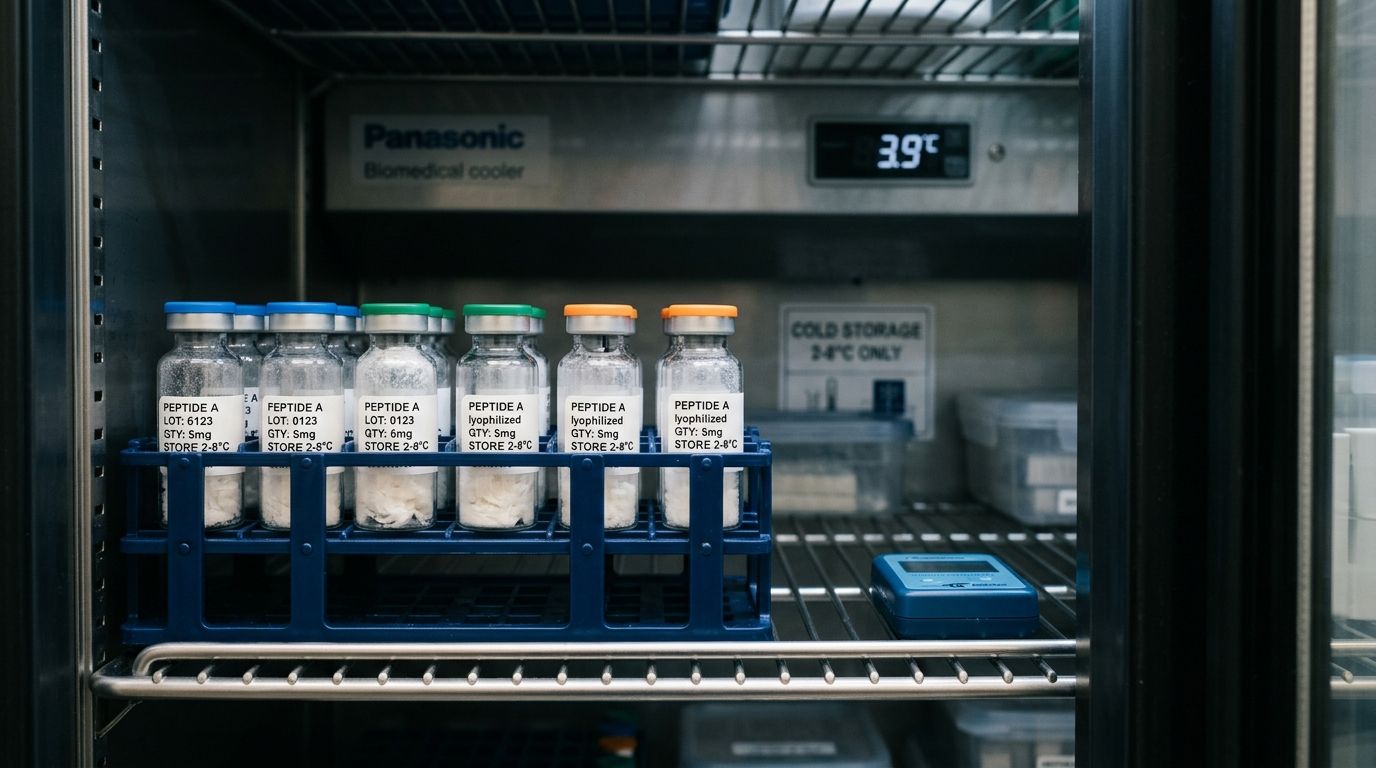
Lyophilized (freeze-dried) research peptides stay stable when stored at -20°C or colder, sealed in the original vial, protected from light and moisture, until reconstitution. The risk most labs overlook: repeated freeze-thaw cycles and ambient humidity exposure degrade the peptide before reconstitution ever happens, even when the vial spends most of its life in a -20°C freezer.
- Store lyophilized peptides at -20°C or colder in the original sealed vial for long-term stability.
- Room-temperature exposure and humidity, not just freezer temperature, cause most pre-reconstitution degradation.
- Let the vial reach room temperature before opening it to keep condensation out of the cake.
- Avoid repeated freeze-thaw of an unopened lyophilized vial — each cycle introduces moisture risk.
- A dedicated laboratory storage case keeps temperature stable during transport between freezer and bench.
Why this matters
A lyophilized peptide is chemically stable in its solid state, which is the entire point of freeze-drying it in the first place. Once it's exposed to moisture, light, or repeated temperature swings before you ever add liquid, that stability starts eroding — and the degradation happens invisibly, with no change in appearance until an analytical review turns up an unexpected impurity peak. Getting pre-reconstitution storage right protects the same peptide sequence and purity you paid for on the lot's certificate of analysis, in 2026 as much as it did a decade ago.
Simple Life Science ships lyophilized peptides with lot-specific documentation so researchers can match storage conditions against defined specifications rather than guess. A properly rated laboratory peptide storage case closes the gap between the shipping cooler and the lab freezer, which is where a surprising amount of pre-reconstitution damage actually occurs.
How do you store peptides before they're reconstituted?
- Keep the peptide in its original, sealed, light-protected vial as received — don't transfer it to another container before use.
- Store at -20°C or colder for any hold period longer than a few days. A manual-defrost or dedicated lab freezer avoids the temperature cycling that auto-defrost units introduce.
- Let the vial equilibrate to room temperature before opening it. Opening a cold vial in a warm, humid room draws condensation directly onto the lyophilized cake.
- Minimize freeze-thaw cycles. Pull only the vials you need for immediate reconstitution and return the rest to -20°C without delay.
- Log storage conditions against the lot's analytical documentation so any deviation is traceable back to a specific vial and date.
| Storage condition | Use case | Verdict |
|---|---|---|
| -20°C or colder, sealed vial | Unopened peptide, long-term hold | Correct default |
| 2-8°C, sealed vial | Short-term hold ahead of near-term use | Acceptable for days, not months |
| Room temperature, sealed vial | Brief handling during transfer only | Minimize exposure |
| Room temperature, opened vial | Extended sit-out before reconstitution | Avoid |
-20°C: long-term storage for unopened lyophilized peptide
-20°C or colder is the correct storage temperature for any lyophilized peptide you're not reconstituting within the next few days. At this temperature the solid-state peptide resists the hydrolysis and oxidation pathways that degrade it in solution or under humidity. The caveat: a freezer that cycles through auto-defrost warms the compartment repeatedly, which functions like a slow freeze-thaw cycle even though the vial never physically leaves the unit.
2-8°C: short-term storage before near-term reconstitution
2-8°C refrigeration works as a short-term holding condition when you know reconstitution is days away, not weeks. It's a reasonable compromise when a freezer isn't immediately accessible, but it isn't a substitute for -20°C storage across a full research program. Peptides with oxidation-prone residues — methionine, cysteine, tryptophan — lose stability faster at refrigerator temperature than at freezer temperature, so sequence matters here as much as the thermometer reading.
Room temperature: how long is it safe to sit out?
Room-temperature exposure should be limited to brief handling windows — moving a vial from a cooler to a freezer, or from storage to the bench right before reconstitution — not extended sit-out. Manufacturers generally advise treating any prolonged room-temperature dwell time as a stability risk rather than a neutral default, since humidity and ambient light both act on the exposed vial the moment it's out of cold, dark storage.
Why peptide storage requirements vary
- Amino acid composition — sequences with methionine, cysteine, or tryptophan oxidize faster under identical storage conditions.
- Salt/counter-ion form — acetate, TFA, and HCl salts differ in hygroscopicity, changing how fast a vial picks up moisture once opened.
- Peptide length and secondary structure — longer or more structured sequences carry more sites vulnerable to degradation than short linear peptides.
- Packaging — amber vials and included desiccant reduce light and moisture exposure compared to unprotected clear vials.
- Intended use timeline — a single-use aliquot tolerates different handling than a vial meant to supply a multi-month research program.
- Lot documentation — the analytical review behind a specific lot sets the actual stability expectation, not a generic rule of thumb.
Source peptides with full lot documentation
Every lot ships with a certificate of analysis and defined specifications.
Related questions
How long can lyophilized peptides sit at room temperature before they degrade?
Room temperature is only appropriate for brief handling, not extended storage — treat any sit-out time beyond a quick transfer as a stability risk, particularly for oxidation-prone sequences. If a vial has been out longer than intended, note the deviation against the lot's documentation before proceeding to reconstitution.
Can you refreeze a peptide vial after it's been reconstituted?
Refreezing applies to the reconstituted solution, not the unopened lyophilized cake, and it isn't the same question as pre-reconstitution storage. Once bacteriostatic water or another diluent has been added, the peptide is in solution and follows a different stability profile than the solid form discussed here — check the bacteriostatic water for peptide reconstitution guide for post-reconstitution handling.
Do peptides need to be stored in the dark?
Yes, light exposure accelerates degradation in many peptide sequences, which is why lyophilized peptides typically ship in amber vials or light-protected packaging. Keeping the vial in its original packaging, inside a freezer, satisfies this without any extra step.
One last thing
Most pre-reconstitution damage doesn't come from a freezer running a few degrees warm — it comes from condensation. Pulling a vial straight from -20°C into a warm, humid lab and opening it immediately draws moisture directly onto the exposed lyophilized cake, which is a faster path to degradation than a short lapse in freezer temperature. Let the vial sit sealed at room temperature for a few minutes before opening it, every time, regardless of how confident you are in your freezer.
Simple Life Science's lyophilized peptides for research labs ship with lot-specific documentation precisely so this kind of handling detail is traceable, not guessed at.
FAQ
How do you store peptides before they are reconstituted?
Store lyophilized peptides at -20°C or colder in the original sealed, light-protected vial until you're ready to reconstitute. Let the vial reach room temperature before opening it to avoid condensation entering the cake.
What temperature should lyophilized peptides be stored at?
-20°C or colder is the standard long-term storage temperature for unopened lyophilized peptides. 2-8°C works as a short-term holding condition when reconstitution is only days away.
How long do lyophilized peptides last unopened?
Unopened lyophilized peptides stored at -20°C or colder retain stability far longer than reconstituted solutions, though the exact stability window depends on the sequence and lot's analytical documentation. Check the certificate of analysis for the specific lot.
Can lyophilized peptides be stored at room temperature?
Room temperature is acceptable only for brief handling, not extended storage. Prolonged room-temperature exposure accelerates degradation, especially in sequences with oxidation-prone residues like methionine or cysteine.
Is it bad to refreeze peptides?
Repeated freeze-thaw of an unopened lyophilized vial is bad because each cycle risks introducing moisture through condensation. Reconstituted peptide in solution follows a separate stability profile from the lyophilized form.
Should peptide vials be protected from light?
Yes, light exposure accelerates degradation in many peptide sequences. Original packaging combined with freezer storage protects against both light and temperature simultaneously.
What happens if a lyophilized peptide gets moisture exposure?
Moisture exposure introduces hydrolysis pathways that degrade the peptide even while it sits in solid form. This is why letting a cold vial equilibrate before opening matters more than most researchers assume.
Do you need a special storage case for peptides?
A dedicated laboratory storage case isn't mandatory but reduces temperature swings during transport between freezer and bench. It matters most for labs moving vials frequently between storage and active use.