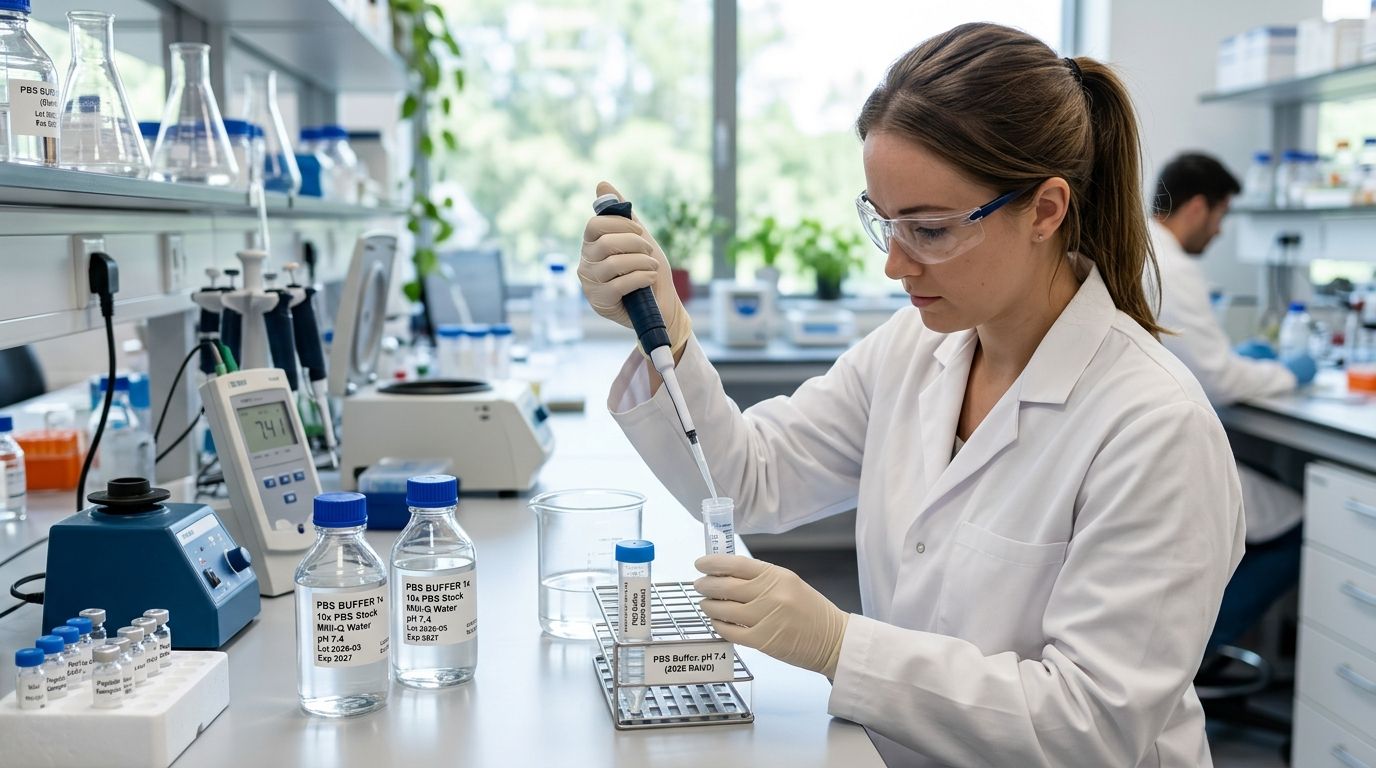
This guide ranks the PBS buffer formulations most commonly specified in peptide research workflows for 2026, based on published buffer chemistry standards and documented use in dilution, binding-assay, and cell-based bioassay protocols.
- 1X PBS at pH 7.4, calcium- and magnesium-free, is the default pbs buffer solutions for peptide research for general dilution and buffer exchange.
- 10X PBS concentrate suits labs preparing large working volumes and reduces per-batch preparation time.
- PBS with 0.05% Tween-20 is the standard for ELISA and peptide binding-assay work in 2026.
- Sterile-filtered, endotoxin-tested PBS is required for any cell-based peptide bioassay.
- Calcium- and magnesium-containing PBS is reserved for receptor-binding studies that specifically call for divalent cations.
Verdict: 1X PBS, pH 7.4, calcium- and magnesium-free wins as the default pbs buffer solutions for peptide research. PBS with 0.05% Tween-20 is best for binding assays. Sterile-filtered PBS is best for cell-based bioassays. 10X PBS concentrate is best for high-throughput labs, and PBS with calcium and magnesium is best for receptor-binding studies.
Why this matters
Buffer selection determines whether a peptide research result is reproducible across lots. A PBS formulation with an undocumented pH shift, an unlisted divalent cation, or unverified endotoxin status introduces variability that has nothing to do with the peptide itself.
Most lyophilized peptide reconstitution work does not use PBS directly — bacteriostatic water for peptide reconstitution is the more common first step. PBS enters the workflow downstream, in dilution series, assay buffers, and cell-based bioassay steps where isotonic, pH-defined conditions are required. Choosing the wrong PBS variant at that stage can undo careful upstream reconstitution.
What makes the best PBS buffer solution for peptide research
- Defined pH specification — documented tolerance around pH 7.2–7.4, not a nominal label
- Divalent cation status stated explicitly — calcium and magnesium presence or absence affects peptide-receptor and peptide-protein interactions
- Endotoxin and sterility documentation — required for any cell-based bioassay use
- Lot-to-lot osmolality consistency — variability here shifts assay baselines between batches
- Format flexibility — 1X ready-to-use, 10X concentrate, or powder, matched to lab throughput
- Available Certificate of Analysis — lot-level documentation a research team can retain for the record
PBS buffer solutions for peptide research: at a glance
| Formulation | Best for | Standout feature | Key limitation |
|---|---|---|---|
| 1X PBS, pH 7.4, Ca/Mg-free | General dilution and buffer exchange | Isotonic, no divalent cation interference | Not sterile by default; requires filtration for cell work |
| 10X PBS concentrate | High-throughput labs | Reduces prep time across large batch volumes | Dilution accuracy depends on lab technique |
| PBS + 0.05% Tween-20 | ELISA and binding assays | Reduces non-specific peptide adsorption to plastic | Not suited to reconstitution or storage use |
| Sterile-filtered PBS (0.22 µm) | Cell-based bioassays | Endotoxin-tested, cell-culture compatible | Shorter open-container shelf life once opened |
| PBS with calcium and magnesium | Receptor-binding studies | Supports divalent cation-dependent binding | Can promote aggregation in some peptide sequences |
| Powder PBS (self-prepared) | Cost-sensitive, high-volume prep | Full control over prep volume and timing | Requires in-house pH verification equipment |
1. 1X PBS, pH 7.4 (Ca/Mg-free): best PBS buffer solution for general peptide dilution
Standard 1X PBS at pH 7.4 without calcium or magnesium is the reference buffer for peptide dilution series and general buffer exchange in 2026 research protocols. The published formulation runs approximately 137 mM NaCl, 2.7 mM KCl, and 10 mM phosphate — a composition documented across cell biology and biochemistry reference protocols for decades.
1X PBS pros:
- Matches physiological ionic strength without introducing divalent cations
- Widely available with documented pH specification
- Suitable base for most dilution and washing steps
1X PBS cons:
- Not sterile-filtered by default
- Requires separate endotoxin testing for cell-based use
Best for: general peptide dilution and buffer exchange. Verdict: Buy.
2. 10X PBS concentrate: best for high-throughput peptide labs
10X PBS concentrate lets labs prepare large working volumes from a single stock, reducing the number of individual preparation steps across a study. This matters for labs running multiple peptide dilution series or plate-based assays in parallel during 2026 study cycles.
10X PBS pros:
- Reduces prep time for large-volume studies
- Stable stock format for extended storage before dilution
- Consistent source composition across a study
10X PBS cons:
- Final pH and concentration depend on accurate dilution technique
- Introduces an extra prep step versus ready-to-use 1X format
Best for: labs preparing high volumes of working buffer. Verdict: Buy for high-throughput setups.
3. PBS with 0.05% Tween-20: best for peptide binding assays
PBS with 0.05% Tween-20 is the standard wash and dilution buffer for ELISA and peptide binding-assay protocols. The detergent reduces non-specific adsorption of peptides to plate surfaces, a documented source of assay signal variability.
PBS-Tween pros:
- Reduces non-specific peptide binding to plastic surfaces
- Standard format across published ELISA protocols
- Compatible with most peptide binding-assay designs
PBS-Tween cons:
- Not appropriate for reconstitution or long-term storage buffer use
- Detergent concentration must be verified against assay-specific protocols
Best for: ELISA and peptide binding assays. Verdict: Buy for assay work only.
4. Sterile-filtered PBS (0.22 µm, endotoxin-tested): best for cell-based peptide bioassays
Sterile-filtered PBS with documented endotoxin testing is required wherever peptide research crosses into cell-based bioassay work. The 0.22 µm filtration step and endotoxin certificate are the documentation a lab needs on file before using PBS in any cell-culture-adjacent protocol.
Sterile-filtered PBS pros:
- Endotoxin-tested for cell-culture compatibility
- Documented sterility supports reproducible bioassay results
- Available with lot-specific certificates
Sterile-filtered PBS cons:
- Shorter practical shelf life once the container is opened
- Typically priced above non-sterile bulk formats
Best for: cell-based peptide bioassays. Verdict: Buy when cell culture is involved.
5. PBS with calcium and magnesium: best for receptor-binding peptide studies
PBS formulated with calcium and magnesium supports studies where divalent cation-dependent binding is part of the research design, such as certain receptor-binding and cell-adhesion protocols. This variant is a deliberate departure from the Ca/Mg-free default and should be selected only when the study design calls for it.
Ca/Mg PBS pros:
- Supports divalent cation-dependent binding interactions
- Matches specific published receptor-binding protocols
Ca/Mg PBS cons:
- Can promote aggregation in some peptide sequences
- Not a substitute for standard dilution buffer in general workflows
Best for: receptor-binding and cell-adhesion peptide studies. Verdict: Buy only when the protocol specifies divalent cations.
6. Powder PBS (self-prepared): best for cost-sensitive, high-volume labs
Powder PBS, reconstituted in-house, gives a lab full control over prep volume, timing, and batch size. This format suits research groups running frequent, high-volume peptide dilution work who maintain their own pH verification equipment.
Powder PBS pros:
- Full control over batch size and prep schedule
- No dependency on ready-to-use stock turnaround
Powder PBS cons:
- Requires in-house pH meter and calibration discipline
- Higher risk of lot-to-lot variability without documented internal QC
Best for: cost-sensitive labs running high buffer volumes. Verdict: Hold unless the lab has verified internal pH-control procedures.
How this ranking was built
Each formulation was assessed against the criteria above: pH specification, divalent cation status, endotoxin documentation, lot consistency, and format flexibility. Formulations were separated by use case rather than ranked on a single leaderboard, because dilution buffer, assay buffer, and bioassay buffer solve different documented requirements.
“A PBS variant is correct or incorrect for a protocol based on its documented cation status and sterility, not on general availability.”
Which PBS buffer solution should you choose?
For most 2026 peptide dilution and buffer-exchange work, 1X PBS at pH 7.4, calcium- and magnesium-free, is the default choice. Move to PBS with Tween-20 for binding assays, sterile-filtered PBS for any cell-based step, and calcium/magnesium PBS only when the protocol specifically requires divalent cations. Keep the Certificate of Analysis for whichever formulation the lab standardizes on — it is the record that ties a result back to a defined buffer lot.
Review peptide documentation and specifications
Check lot records and analytical specifications before your next study.
FAQ
What is the best PBS buffer for peptide research in 2026?
1X PBS at pH 7.4, calcium- and magnesium-free, is the standard default for peptide dilution and buffer-exchange work in 2026. Assay-specific work shifts to PBS with Tween-20 or sterile-filtered PBS depending on the protocol.
Is PBS the same as bacteriostatic water for peptide reconstitution?
No. PBS is an isotonic dilution and assay buffer, while bacteriostatic water is typically used for initial reconstitution of lyophilized peptides. Most labs use bacteriostatic water first and PBS downstream in dilution or assay steps.
Does PBS need calcium and magnesium for peptide research?
Only when the protocol specifically requires divalent cation-dependent binding, such as certain receptor-binding studies. Standard dilution work uses calcium- and magnesium-free PBS to avoid unintended cation interference.
Why use PBS with Tween-20 for peptide assays?
Tween-20 at 0.05% reduces non-specific adsorption of peptides to plate surfaces, which is a documented source of variability in ELISA and binding-assay signal. It is not appropriate for reconstitution or storage buffer use.
Does PBS need to be sterile for peptide research?
Sterility and endotoxin testing are required whenever PBS is used in cell-based bioassay work. General dilution or wash steps outside cell culture do not require the same documentation.
Can I make my own PBS buffer for peptide research?
Powder PBS reconstituted in-house works for labs with verified pH-control equipment and internal QC procedures. Without documented internal calibration, ready-to-use 1X or 10X PBS reduces lot-to-lot variability risk.
What pH should PBS be for peptide research?
Standard PBS for peptide research is specified at pH 7.4, matching physiological isotonic conditions. Labs should confirm the documented pH tolerance on the Certificate of Analysis rather than relying on a nominal label.
How does PBS choice affect peptide binding assay results?
An undocumented shift in pH, an unlisted divalent cation, or unverified sterility status introduces variability unrelated to the peptide being studied. Matching the PBS formulation to the assay's documented requirements keeps results comparable across lots.
One last thing
Calcium- and magnesium-containing PBS is a documented trigger for aggregation in certain peptide sequences — a detail that gets missed when a lab defaults to "standard PBS" without checking which variant a protocol actually calls for. Confirm cation status against the written protocol before every study, not just the first time.