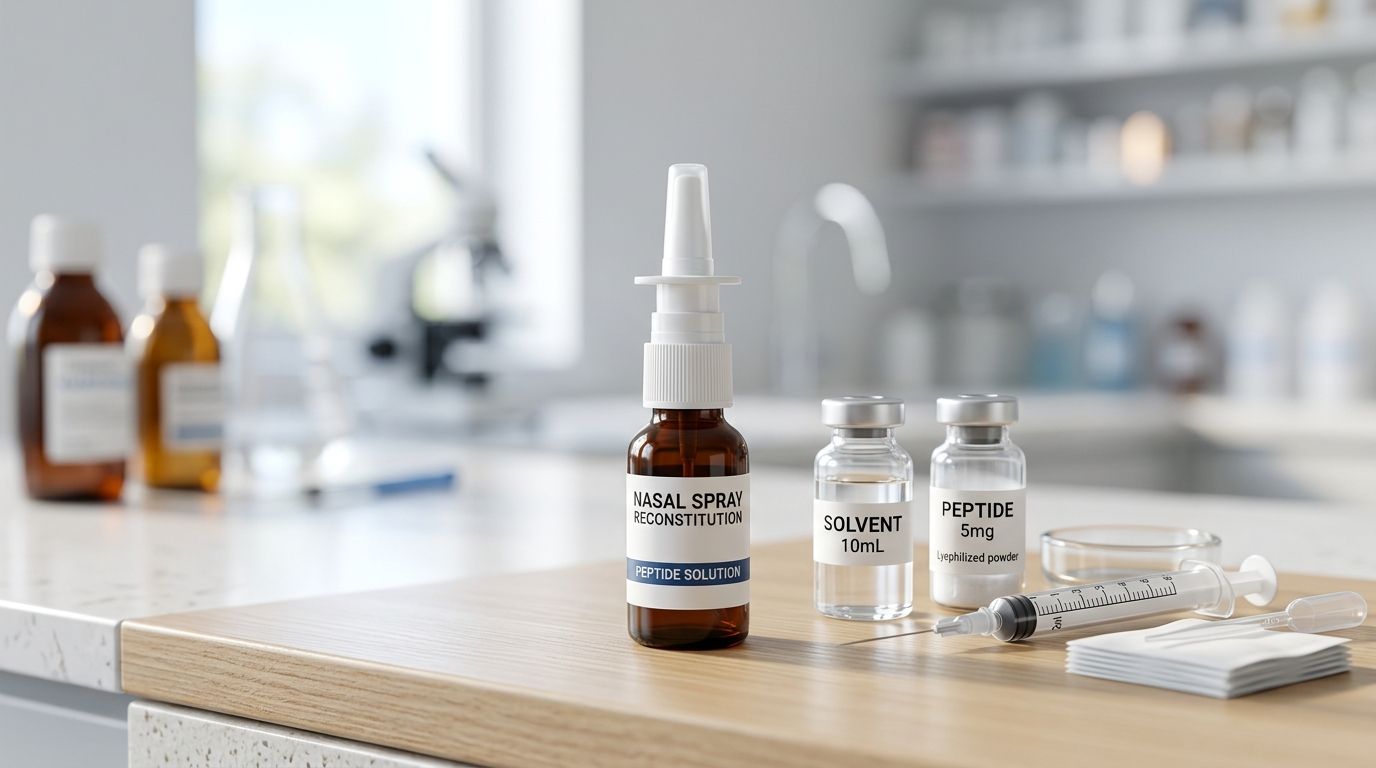
Laboratory teams preparing peptide solutions for nasal-device research in 2026 start with the reconstitution vehicle, not the spray hardware. The solvent choice controls solubility, lot documentation, pH stability, and whether multi-draw aliquots remain within written acceptance criteria.
- Best overall nasal spray reconstitution solution for peptides in 2026: bacteriostatic water for multi-draw research aliquots.
- Best isotonic option: 0.9% saline when osmolarity must match nasal-formulation protocols.
- Best for basic peptides with poor water solubility: dilute acetic acid under defined scope.
- Skip preservative-free water for multi-day shared vials; document single-use only.
- Simple Life Science supplies lyophilized research peptides that require written reconstitution records.
Why this matters
Reconstitution is a controlled laboratory step. For nasal-spray formulation research, the vehicle is part of the method: it must be named on the protocol, matched to the peptide’s charge and hydrophobicity, and recorded against the lot. Teams that treat the diluent as an afterthought produce irreproducible concentrations and incomplete provenance.
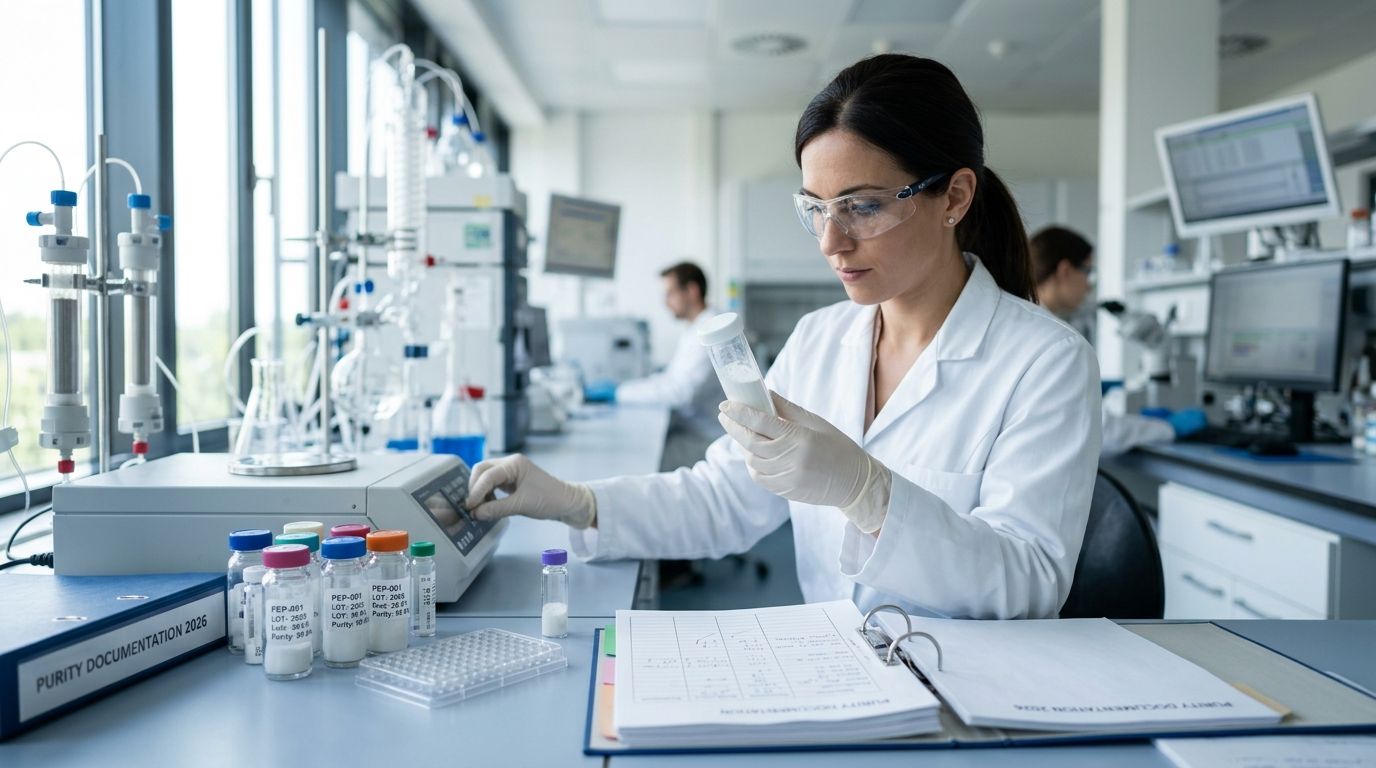
Simple Life Science supplies lyophilized research peptides, bulk peptide API, and custom synthesis services to qualified laboratory researchers and institutional buyers. Buyers still need a defined reconstitution path before any device-level work begins. Pair solvent selection with how you store peptides before they are reconstituted so the dry lot and the wet solution stay under the same documentation system.
All options below are research-use materials and method choices. Nothing here is guidance for human administration, clinical use, or consumer products.
Best overall: bacteriostatic water. Best for isotonic nasal-formulation research: 0.9% saline. Best budget single-use option: sterile water for injection. Best for poorly water-soluble basic peptides: dilute acetic acid. Best when pH control is mandatory: phosphate-buffered saline (PBS).
What makes the best nasal spray reconstitution solutions for peptides
Rank vehicles against written laboratory criteria, not marketing claims:
- Documented composition — Certificate of analysis, stated preservative level, and lot identity on every bottle.
- Peptide compatibility — Charge, isoelectric point, and known solubility limits under the planned concentration.
- Preservative status — Multi-draw vs single-use rules fixed in the protocol before the first vial is opened.
- Osmolarity and pH — Fit to the nasal-device research method and any buffer window named in the brief.
- Analytical follow-through — Ability to confirm concentration and integrity after reconstitution under the lab’s acceptance criteria.
- Storage and hold time — Refrigerated hold limits stated in writing and rechecked against the reconstituted peptide refrigeration window.
Nasal spray peptide reconstitution solutions at a glance
| Solution | Best for | Standout feature | Key limitation |
|---|---|---|---|
| Bacteriostatic water | Multi-draw research aliquots | Benzyl alcohol preservative supports repeated aseptic withdrawals | Not for protocols that ban preservatives |
| 0.9% saline | Isotonic nasal-formulation research | Defined NaCl content and osmolarity | May reduce solubility for some sequences |
| Sterile water for injection | Single-use, preservative-free prep | Minimal excipient profile | No multi-day shared-vial use |
| Dilute acetic acid | Basic peptides with poor water solubility | Low pH improves dissolution for many basic sequences | pH must stay inside method limits |
| PBS | Buffered pH control | Fixed phosphate system for tight pH windows | Ionic strength can affect some peptides |
1. Bacteriostatic water: best nasal spray reconstitution solution for multi-draw research aliquots
Bacteriostatic water is sterile water containing a stated level of benzyl alcohol as a preservative. In 2026 peptide laboratories it remains the default multi-draw vehicle when the written method allows a preservative and the team needs repeated aseptic withdrawals from one vial.
Define the target concentration, confirm the peptide’s solubility in water, then reconstitute under the lab’s aseptic procedure. Plan aliquot volumes so each draw stays inside the documented hold time. Produce the solution, verify concentration if the method requires it, and document lot numbers for both peptide and diluent.
Bacteriostatic water pros:
- Supports multi-draw workflows when the protocol permits benzyl alcohol
- Widely available with lot-level documentation from research suppliers
- Familiar acceptance criteria across institutional SOPs
- Pairs cleanly with refrigerated hold rules already used for reconstituted peptides
Bacteriostatic water cons:
- Excluded from preservative-free methods
- Benzyl alcohol can be incompatible with some analytical endpoints
- Not a buffer; pH drift still needs monitoring for sensitive sequences
Best for: Multi-draw research reconstitution where the method names bacteriostatic water and records preservative content.
Verdict: Buy for standard multi-aliquot peptide prep when preservatives are in scope. Review the dedicated bacteriostatic water for peptide reconstitution notes before locking the SOP.
2. 0.9% saline: best for isotonic nasal-formulation research
Isotonic saline (0.9% NaCl) is the vehicle of choice when the research brief requires osmolarity matched to common nasal-formulation test conditions. It is still a laboratory diluent: composition, sterility claim, and lot identity belong on the batch record.
Use saline when the peptide dissolves adequately in saline at the planned concentration and the device or in vitro assay specifies isotonic conditions. If solubility fails, do not force the method—move to a scoped alternative such as dilute acid or a co-solvent system under a revised written scope.
0.9% saline pros:
- Defined osmolarity supports isotonic nasal-device research designs
- Simple composition eases documentation and incoming review
- Compatible with many institutional sterility and storage SOPs
0.9% saline cons:
- Ionic strength can suppress solubility for some sequences
- No preservative unless a separate preserved saline is specified
- pH is not tightly buffered without additional system design
Best for: Nasal-formulation research methods that require isotonic vehicle conditions and water-soluble peptides.
Verdict: Buy when osmolarity is a named acceptance criterion. Hold if solubility data for the lot is incomplete.
3. Sterile water for injection: best preservative-free single-use option
Sterile water for injection (or equivalent research-grade sterile water) is the minimal-excipient choice. It fits single-use reconstitution events where the protocol bans preservatives and each vial is opened once, used, and closed out of the method.
Define single-use rules in writing before the first reconstitution. Plan volumes so leftover solution is not held as a multi-day shared stock unless a separate stability study justifies it. Verify and document immediately after prep.
Sterile water pros:
- No preservative interference with sensitive assays
- Clean composition for methods that require minimal excipients
- Straightforward lot documentation and incoming review
Sterile water cons:
- Unsuitable as a multi-draw shared vial without additional controls
- No inherent antimicrobial protection after opening
- Offers no pH or osmolarity control on its own
Best for: Preservative-free, single-use peptide reconstitution under a closed research protocol.
Verdict: Buy for single-use prep. Skip as a multi-day open stock.
4. Dilute acetic acid: best for basic peptides with poor water solubility
Many basic peptides dissolve poorly in neutral water. A dilute acetic acid vehicle—concentration fixed in the method, not improvised—raises solubility for sequences that remain cloudy or particulate in water or saline. The acid level, final pH, and neutralization steps (if any) must appear in the written scope before work starts.
Simple Life Science research peptides arrive lyophilized with defined specifications; poorly soluble lots still need a scoped solvent path, not ad-hoc acid addition. Confirm solubility in a small feasibility check, then scale under the same acceptance criteria.
Dilute acetic acid pros:
- Improves dissolution for many basic, poorly water-soluble sequences
- Concentration and pH can be stated as clear method parameters
- Compatible with common analytical characterization workflows when documented
Dilute acetic acid cons:
- Outside methods that require near-neutral pH at all times
- Over-acidification risks sequence or assay interference if limits are ignored
- Requires extra verification steps versus plain water
Best for: Basic peptides that fail neutral aqueous reconstitution inside the planned concentration window.
Verdict: Buy only under a written acid-reconstitution scope. Wait until solubility and pH limits are approved.
5. PBS: best when buffered pH control is required
Phosphate-buffered saline supplies a fixed phosphate buffer system plus saline tonicity. Choose PBS when the nasal-device research method names a tight pH window and the peptide remains soluble and stable inside that buffer.
Confirm buffer strength, pH set point, and any calcium/magnesium variants against the protocol. Document the PBS lot the same way you document the peptide lot. If the peptide precipitates in PBS, revise the vehicle rather than adjusting pH outside the approved range.
PBS pros:
- Named pH control for methods with narrow buffer windows
- Isotonic variants support device-level research designs that need both pH and salt control
- Standard reagent with clear supplier documentation paths
PBS cons:
- Phosphate and ionic strength can reduce solubility or alter aggregation for some peptides
- Not appropriate when the method requires a phosphate-free system
- Multi-draw use still needs preservative policy defined separately
Best for: Research methods that specify buffered pH and tolerate phosphate systems.
Verdict: Buy when pH is a hard acceptance criterion. Hold if solubility in PBS is unproven for the lot.
Submit a research brief
Define sequence, specification, and analytical scope for a written quotation.
How we ranked
Ranking followed the six criteria above: documented composition, peptide compatibility, preservative rules, osmolarity/pH fit, analytical follow-through, and storage hold discipline. Preference went to vehicles that institutional labs can name in an SOP, receive with lot records, and verify against acceptance criteria. Niche co-solvents such as DMSO were excluded from the top five because they require separate compatibility and residual-solvent controls that most nasal-formulation research briefs do not start with in 2026.
No consumer outcomes, dosing schemes, or clinical endpoints entered the ranking. The frame is laboratory reconstitution for research peptides only.
Which nasal spray reconstitution solution for peptides should you choose?
Default for multi-draw research aliquots in 2026: bacteriostatic water, provided the method allows benzyl alcohol and lot documentation is complete. Default for isotonic nasal-formulation work: 0.9% saline when the peptide dissolves at the target concentration. Default for preservative-free single-use prep: sterile water. Move to dilute acetic acid only after a feasibility note shows neutral aqueous failure for a basic sequence. Use PBS when the written pH window requires it.
If you are sourcing the peptide itself, start from defined lyophilized material with lot-level records—lyophilized peptides for research labs outlines the specification posture buyers should demand—then lock the vehicle in the same documentation chain. Simple Life Science positions reconstitution as a documented stage after Define and Plan, not as an informal bench habit.
FAQ
What is the best nasal spray reconstitution solution for peptides in 2026?
Bacteriostatic water is the best overall choice for multi-draw research aliquots when the written method allows benzyl alcohol. Use 0.9% saline when isotonic conditions are required and sterile water for preservative-free single-use prep.
Is bacteriostatic water better than sterile water for peptide reconstitution?
Bacteriostatic water is better for multi-draw research vials because the preservative supports repeated aseptic withdrawals. Sterile water is better when the protocol bans preservatives and each preparation is single-use only.
Can I use saline to reconstitute peptides for nasal-device research?
Yes, when the peptide is soluble in 0.9% NaCl at the planned concentration and the method requires isotonic conditions. Confirm solubility and record the saline lot on the batch documentation.
When should dilute acetic acid be used for peptide reconstitution?
Use dilute acetic acid only under a written scope for basic peptides that fail neutral aqueous reconstitution. Fix acid concentration, final pH limits, and verification steps before scaling.
Does PBS work as a nasal spray reconstitution vehicle for peptides?
PBS works when the research method needs buffered pH control and the peptide remains soluble in the phosphate system. It is not the default if phosphate or ionic strength conflicts with the sequence or assay.
How should reconstituted peptides be stored in 2026 laboratory practice?
Store reconstituted peptides under the hold time and temperature named in the method, typically refrigerated, and document open-date and discard rules. Multi-draw vials need a preservative policy stated in the same record.
Do reconstitution solutions replace analytical testing of the peptide lot?
No. The vehicle does not replace incoming or release testing of the peptide. Concentration and integrity checks after reconstitution still follow the laboratory’s acceptance criteria and lot documentation.
Are these reconstitution solutions for human or clinical use?
No. The solutions and practices described here are for qualified laboratory research only. They are not instructions for human administration, clinical care, or consumer products.
One last thing
The vehicle you refuse to name on the batch record is the one that breaks reproducibility. In 2026, treat the reconstitution solution as a controlled material with the same provenance expectations you apply to the peptide lot—identity, composition, open dating, and discard rules in one place. That single discipline separates clean nasal-device research data from unrecoverable concentration drift.